
 En
When Should You Use Coupling Nuts? Common Applications and Selection Considerations
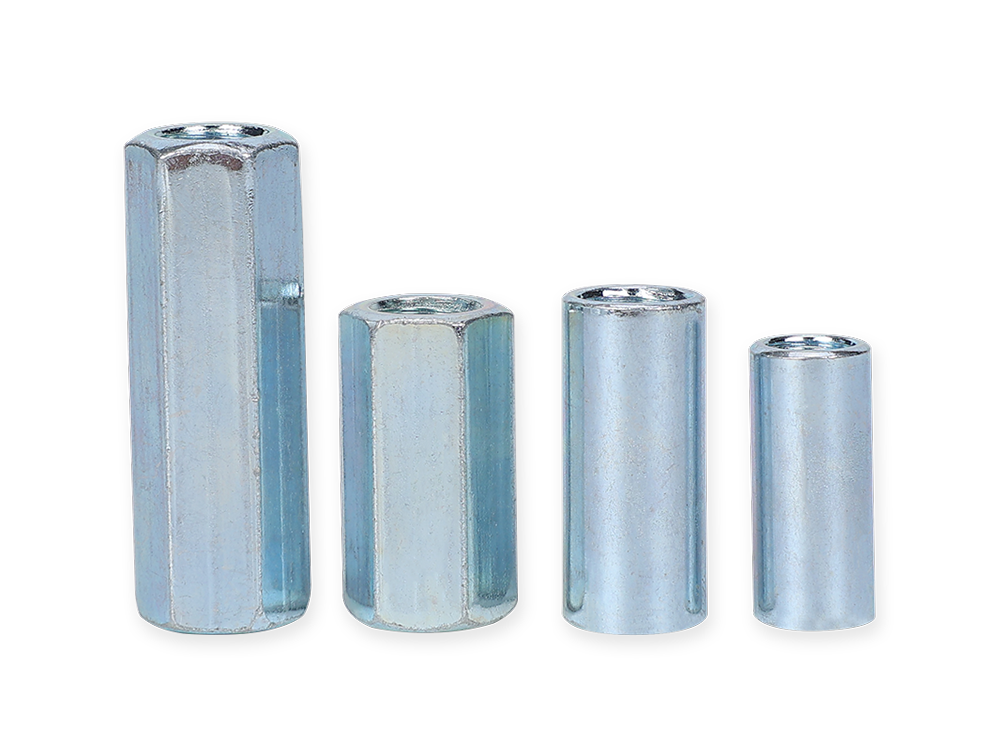
A coupling nut is an elongated internally threaded fastener primarily used to connect two externally threaded rods. It can also be used to extend threaded assemblies. Common types include hex coupling nuts and reducing coupling nuts.
Compared with standard nuts, coupling nuts typically have a longer body that provides additional space for thread engagement. They are commonly used to extend threaded rods, connect threaded hanger rods, and assemble certain mechanical components. Their performance depends on the material, thread specifications, engagement length, and applied loads, so strength should not be judged by appearance or length alone.
When Should You Use Coupling Nuts?
1Extending Threaded Rods
When an existing threaded rod is too short for the required installation distance, a coupling nut can connect it to another compatible threaded rod to extend the assembly. Typical applications include equipment installation, threaded hanger rods, and support assemblies.
If the connection is subject to tensile, vibrational, or dynamic loads, verify the load capacity of the connection, the required thread engagement, and whether the complete assembly meets the design requirements.
2Connecting Two Threaded Rods
In building installations, mechanical equipment, and pipe support systems, coupling nuts can join two rods with compatible external threads. This can simplify sectional transportation, on-site assembly, and subsequent maintenance.
Before installation, verify that both rods have matching thread specifications and that each reaches the required engagement depth. If the coupling nut has a center inspection hole, it can help check rod insertion, but it does not replace the specified thread engagement requirements.
3Connecting Threaded Rods of Different Sizes
When two rods have different thread specifications, a reducing coupling nut may be suitable. Selection requires checking the nominal diameter, pitch, thread series, and direction of each end to ensure compatibility with the corresponding rod.
A reducing coupling nut cannot connect arbitrary thread sizes. For load-bearing or safety-critical applications, its strength and suitability must also be verified.
Common Applications of Coupling Nuts
| Application | Typical Use | Key Considerations |
|---|---|---|
| Building installations | Connecting or extending threaded hanger rods and tie rods | Design loads and thread engagement length |
| Mechanical equipment | Joining threaded rods and extending assemblies | Thread accuracy and vibration conditions |
| Pipe support systems | Extending hanger rods and connecting support components | Support loads and corrosive environments |
| Equipment maintenance | Replacing or extending threaded components | Existing thread specifications and material compatibility |
Suitability should be determined by the actual assembly, applied loads, and engineering requirements rather than the application category alone.
Material and Surface Treatment Options for Coupling Nuts
The material and surface treatment of a coupling nut affect its corrosion resistance, suitability for the operating environment, and maintenance requirements. Selection should account for service conditions, mating rods, and design specifications.
▹Carbon steel coupling nuts: Commonly used in general mechanical and building applications. Appropriate protective coatings or plating may be applied depending on the environment. Corrosion protection deserves particular attention in damp, outdoor, or chemically aggressive conditions.
▹Stainless steel coupling nuts: Suitable for applications requiring corrosion resistance. However, corrosion performance varies by stainless steel grade, so the specific medium and operating temperature should be considered.
▹Zinc plating: Commonly used to improve the corrosion resistance of steel fasteners. Actual performance depends on the coating type, thickness, environmental conditions, and maintenance.
▹Material compatibility: Coupling nuts and threaded rods should be compatible in terms of strength, corrosion resistance, and assembly requirements. When dissimilar metals are in contact, the risk of galvanic corrosion should also be assessed in the specific environment.